


Reducing environmental impact is a fundamental topic in ESG strategies, even for service and digital companies, whose ecological footprint is usually quite contained. We consider environmental responsibility an “existential” duty.

Social
The social sphere encompasses attention to people, starting with the company’s employees; respect for clients and partners; gender equality and inclusion; and the relationship with the territory and community.

Governance
Governance is the system of rules and decisions that guides and controls an organization. It defines responsibilities, transparency, and decision-making structure, promoting efficiency and stakeholder trust. In the ESG context, it sets the strategies.

The materiality matrix identifies the topics that are relevant to an organization and its ability to create economic, environmental, and social value for itself, its stakeholders, and society.
Our first matrix is the result of a completed questionnaire, shared reflections, and an ex-post analysis of the convergence between IMC Group’s material topics and the Sustainable Development Goals of the 2030 Agenda.
It is the compass that guides the CSR activities of our Group.
We pursue it through a constant commitment to anticipating and meeting our Clients’ needs, offering transformation pathways that help them achieve their business objectives, generating sustainable value. We achieve this goal thanks to our know-how, supported by enabling and innovative technologies.
It is one of our main areas of expertise: it is a complex activity involving processes and people, and every element is important for everything to work. That is why we work by carefully designing processes and technologies. This approach allows us to apply our risk management skills in the ESG domain, both within the Group and with our Clients.
We are committed to developing an ethical culture within the company, we pursue our business objectives guided by our values and principles, we apply and propose to clients effective GRC strategies that are respectful of the social and environmental context.
We act and promote process and technology innovation with the aim of driving new business models that respect sustainability principles and adopt responsible and equitable organizational approaches. The continuous search for innovative solutions characterizes our approach and allows us to constantly improve our internal processes and our offering to the client.
We are a low environmental impact company. Nevertheless, aware of the importance of cooperating to reduce emissions and promote sustainable growth, we adopt responsible consumption practices, work in an eco-sustainable building, commit to preventing and reducing our consumption, and, where possible, recycling the materials we use.
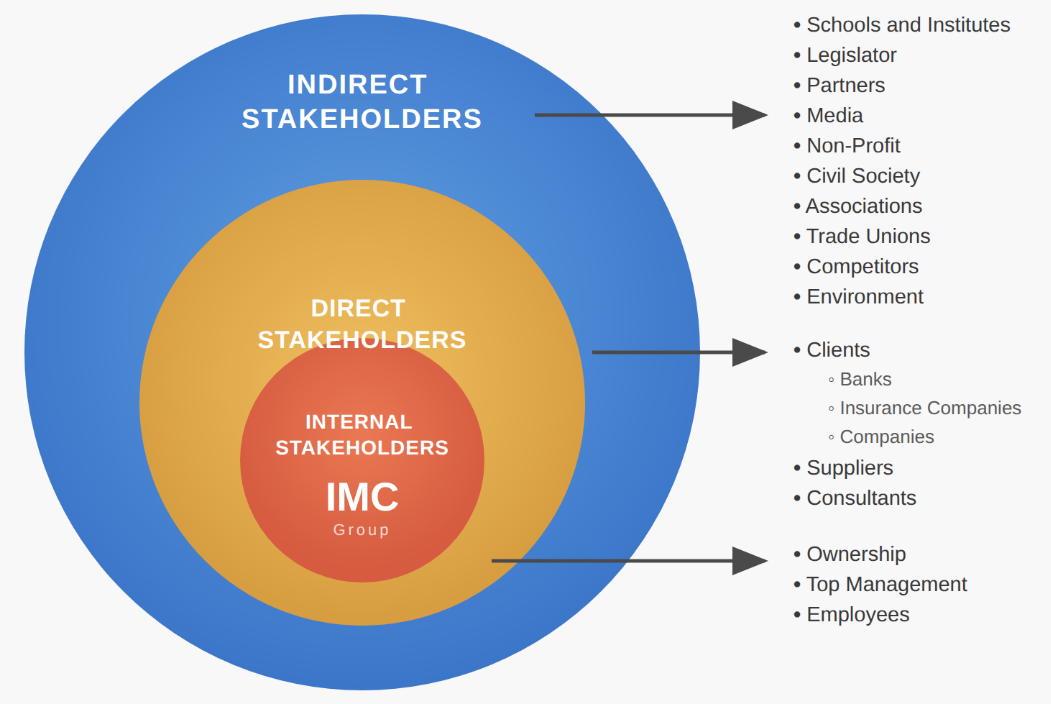
The stakeholder map identifies the interested parties in relation to IMC Group’s activities.
We have outlined a wide range of entities with respect to which we are aware of having a direct or indirect impact, and which represent interlocutors with whom we want to engage and collaborate.
The stakeholder map is a constant reference point for our business and CSR activities.
It is the positive energy that helps us complete our projects with determination and respect for others and the environment in which we operate. It stimulates us to give our best, to renew enthusiasm and awareness in what we do, and to build trust and satisfaction within the Team and the people we work with.
It is the spark that drives us to be curious in imagining ever better solutions. It is the engine of innovation in the products and services we conceive, of our constant attention to market needs, of our determination to satisfy our clients, of significant investments in research and development, and in being perceived as precursors of the future.
It is the awareness that individual ideas or actions are not in competition, but contribute to initiating a participatory process to achieve a common goal. Trusting relationships arise from feeling confident in one’s own abilities, trusting in others’ experiences, and learning from everyone’s knowledge.
It is the result of knowledge and skills blended together and matured by each of us. It is our distinctive element, which translates into the effectiveness of our actions, efficiency in achieving objectives, correctness in behaviour, precision in managing attention points, awareness in assuming responsibilities, and respect for everything and everyone.
It is the ability to put oneself in another’s shoes, understanding their problems, desires, doubts, and expectations. It is the heart of our approach, of our way of living relationships, and we express it by accompanying our interlocutor on their journey, on tiptoe, respecting and considering them as human beings, before seeing them as a client, colleague, or collaborator.
The United Nations 2030 Agenda, with its 17 goals (SDGs), has been guiding companies and institutions in sustainable development since 2015, towards the creation of a fairer world and a healthy natural environment. It is a unitary guidance document, to which one adheres in its entirety, also because the various goals are interconnected. However, each company can identify specific themes on which it can commit and contribute in an organic and continuous manner. IMC Group, through a convergence analysis between the 17 goals of the Agenda and its own areas of competence, has identified 5 reference themes that, together with the Materiality Matrix, outline the Corporate Social Responsibility path.

| Cookie | Duration | Description |
|---|---|---|
| _GRECAPTCHA | _GRECAPTCHA | |
| cli_user_preference | 1 year | The cookie is set by the GDPR Cookie Consent plugin and is used to store whether or not user has consented to the use of cookies. |
| cookielawinfo-checkbox-advertisement | 1 year | Set by the GDPR Cookie Consent plugin, this cookie records the user consent for the cookies in the "Advertisement" category. |
| cookielawinfo-checkbox-analytics | 1 year | Set by the GDPR Cookie Consent plugin, this cookie records the user consent for the cookies in the "Analytics" category. |
| cookielawinfo-checkbox-functional | 1 year | The GDPR Cookie Consent plugin sets the cookie to record the user consent for the cookies in the category "Functional". |
| cookielawinfo-checkbox-necessary | 1 year | Set by the GDPR Cookie Consent plugin, this cookie records the user consent for the cookies in the "Necessary" category. |
| cookielawinfo-checkbox-others | 1 year | Set by the GDPR Cookie Consent plugin, this cookie stores user consent for cookies in the category "Others". |
| CookieLawInfoConsent | 1 year | CookieYes sets this cookie to record the default button state of the corresponding category and the status of CCPA. It works only in coordination with the primary cookie. |
| elementor | never | This cookie is used by the website's WordPress theme. It allows the website owner to implement or change the website's content in real-time. |
| viewed_cookie_policy | 11 months | The cookie is set by the GDPR Cookie Consent plugin and is used to store whether or not user has consented to the use of cookies. It does not store any personal data. |
| Cookie | Duration | Description |
|---|---|---|
| _ga | 1 year 1 month 4 days | Google Analytics sets this cookie to calculate visitor, session and campaign data and track site usage for the site's analytics report. The cookie stores information anonymously and assigns a randomly generated number to recognise unique visitors. |
| _ga_* | 1 year 1 month 4 days | Google Analytics sets this cookie to store and count page views. |
| CONSENT | 2 years | YouTube sets this cookie via embedded youtube-videos and registers anonymous statistical data. |
| li_gc | 6 months | Used to store consent of guests regarding the use of cookies for non-essential purposes |
| li_sugr | 90 days | Used to make a probabilistic match of a user's identity outside the Designated Countries. |
| ln_or | This cookie is set by LinkedIn and is used to determine if Oribi analytics can be carried out on a specific domain |
| Cookie | Duration | Description |
|---|---|---|
| li_sugr | 90 days | Used to make a probabilistic match of a user's identity outside the Designated Countries. |
| VISITOR_INFO1_LIVE | 5 months 27 days | A cookie set by YouTube to measure bandwidth that determines whether the user gets the new or old player interface. |
| YSC | session | YSC cookie is set by Youtube and is used to track the views of embedded videos on Youtube pages. |
| yt-remote-connected-devices | never | YouTube sets this cookie to store the video preferences of the user using embedded YouTube video. |
| yt-remote-device-id | never | YouTube sets this cookie to store the video preferences of the user using embedded YouTube video. |
| Cookie | Duration | Description |
|---|---|---|
| AnalyticsSyncHistory | 1 month | Used to store information about the time a sync took place with the lms_analytics cookie |
| li_gc | 6 months | Used to store consent of guests regarding the use of cookies for non-essential purposes |
| Cookie | Duration | Description |
|---|---|---|
| bcookie | 2 years | LinkedIn sets this cookie from LinkedIn share buttons and ad tags to recognize browser ID. |
| bscookie | 1 years | LinkedIn sets this cookie as a Browser Identifier cookie used for diagnostic purposes. |
| lang | session | LinkedIn sets this cookie to remember a user's language setting. |
| lidc | 1 day | LinkedIn sets the lidc cookie to facilitate data center selection. |
| UserMatchHistory | 1 month | LinkedIn sets this cookie for LinkedIn Ads ID syncing. |